Day Three: Tell Your Story

Jesus said, “Go home to your own people and tell them how much the Lord has done for you, and how he has had mercy on you.” Mark 5: 1-19

The story is bewildering. It sounds like foreign language. This should not blind us to the fact of its central message. This has to do with the setting of the jewel and not the jewel itself. It tells of what Christ did for a man long ago and also what he can do for the soul today giving him a chance.

Some think that religion has more weight than wings. That its best benefits are rather trifles. But in these seeming trifles are the great things – priceless. Supreme things.

Tell what great things the Lord has done for thee.”

Have you such a story to tell? What is the Lord is doing for you? Can it be described by the word “Great”? If not, you have lost your spiritual birthright. Your religion is not to you for which it is intended. But not God’s fault. Whenever Christ has a chance, great things happen to that soul – such is here the case.

Look at the man describe in Mark 5 – the description must have come from the pen of an eyewitness. The boat had hardly landed when this ghastly figure rushed out from the tombs half naked – unkept, half mad. A person with whom we feel little kinship. We are far saner and more respectful. The difference, however, is that of degrees rather than in kind.

What was his trouble? A divided personality. In answer to Jesus, my name is Legion. Not one, but many. Not so much a personality as a battleground. He was at war with himself. Being pulled in a thousand different directions – thousands of impulses and passions were warring with his soul. Such we meet today in the hospitals on the streets and in our homes. Not so pronounced, but the conflict is there. All know something of the tragedy of a divided personality.

This fact is emphasized in modern psychology. We are possessed with conscious and subconscious minds. In the subconscious mind are the driving instincts that have come to us from our ancestors. Instincts without conscience. Have a conscience, we say. Here is no moral sense. Gratified in their one fulfillment without attention to right or wrong. But in the conscious mind there is the sense of oughtness. I must do this or I must not do that. The conscious mind rises up against the subconscious mind. Our ideas fight with our instincts. Our higher self fights battles with our lower self.

A divided personality – incarnate civil war, victims of the deepest of deepest conflicts. The conflict with ourselves. Long before modern psychology, Bible writers discovered this fact. Divided personalities, conscious and subconscious mind. Here is a man who is conscious that he loves the Lord. A man of piety and prayer. He is kneeling with his face turned up to God. But there is another self, refusing to kneel. Laughing and jeering at him when his higher self seeks to pray. Out of the agony of such conflict he cries to God, “Unite my heart to fear thy name.” He prays for unified personality, a wholehearted devotion to God.

Here is another who is deeply religions, but seems more sensitive to the lure of evil than to the good. In spite of this he cannot give himself wholly to the lower. He has gone in to the far country of his choice, but he can’t feel at home there. Therefore, he cries out in his prayer “My soul cleaveth unto the dust, quicken thou me according to thy word,”

The man of the text being at war with himself was naturally wretched. Always night and day crying and cutting himself with stones. Fighting himself, always his worst enemy. He is a stranger to happiness. No one with a divided personality can ever be happy.

Here is another great soul in the midst of the age-old conflict, Paul. He is headed for the high road, but when he begins to climb, he slips. He cries out “O wretched man that I am, who shall deliver me.” I know of a man who lived in excellent circumstances, committed suicide and left this as an explanation. “I was tired of fighting with myself.”

The man of the text being divided and wretched was also antisocial, separated himself from his fellows. Lived alone, no one could tame him. At war with himself. At war with others. It is ever so to ascertain degree with all who have a divided personality. We explode, slam the door, break the dishes. Stab right and left with the sword, the tongue. Tell how poorly we slept how badly we feel and call it our nerves.  But so often it is for the lack of inward harmony. Those torn with inward strife are hard to live with. The demoniac being unable to live with others was equally unable to live for others.

He was or had a divided personality. He was wretched. He was antisocial and he was incurable. He had no hope for himself. Others had no hope for him. He was beyond help. No one could tame him. Divided wretched, unable to live with or for others. An extreme case. Few can recognize any kinship with him. But his needs were and are our needs. What Jesus did for him is just what Jesus longs to do for each of us. He is still able to save to the uttermost.

What did Jesus do for him? He gave him a unified personality. He can do that for us. We can hardly reach the high goal except through him. Certainly no one can find the inward peace by yielding to the basic self. And whatever one may do, he can’t quite hush the voice that calls from the heights.

Lady Macbeth, the most heartless woman of all literature, seemed to have had her prayer answered when she prayed to the demons to take her milk for gall. She could turn her husband to a murdering traitor. Plot the death of her royal guest with devilish eagerness. She was so bad to seem to have no feeling. But not so in her waking hours she was by force able to hide the conflict raging within. Asleep the conflict reveals itself when she seeks to cleanse her hands from the bloody deed. “Out damn spot, out I say.”

We find the unified personality by taking the high road, not the low road. Listen once more to Paul’s anguish cry “O wretched man that I am, who shall deliver me? Who indeed? Is there no answer? There is “I thank God through Jesus Christ. Thus, he sings “there is therefore no condemnation.” No inward strife, the heart no longer condemns us. With Christ’s gift of a unified personality there is inward peace. A surrendered life to him does just that. Peace, I leave with you, my peace I give unto you.

Every man’s religion ought to give him that inward unity which has its assurance in inward peace.

Jesus enabled this man to live with and for his fellows. To live with and for those with who it was impossible for him to live before this contact with Jesus. The broken home. The man met Christ and Christ enabled him to go back and rebuild the broken home. This is the Christian test. This is the test that every man should put his religion to. Can you get along with people? A Christian will certainly be able to meet the test. Live with them and for them.

Here are some of the things that our Lord can do for us. Give us unified personalities and inward peace. Enable us to live with and for our fellows.

How are we to set out to realize the great things the Lord longs to do for us? The first step, repent the and be converted. Old fashion term you say. But if it is and our group has dropped the term, psychologist have taken it up. Conversion is a fact. We may be born anew. We can be born from above or below.

The young man, the Christian, a ministerial student, hopeful. Bright outlook. Well thought of promising. A few years later, I met him. He had become associated with scoundrels and in their fellowship had become reborn, born from below. To be born from above must change the master passion of our lives. Instead of self-centered must become Christ-centered. Matthew, follow me, he did, that was his spiritual birthday. Jack London discovers this in “The Call of the Wild” as Buck becomes the hero. On the way to arrive, the master dies. Buck is reborn by the old instincts. A dog needs a master, he cannot arrive without a master.

When a man arrives at his best something has mastered him. It is not what he possesses but what possesses the man.

We need a Master. Put your hand in his and he will change your discord into winsome music. Take a chance to meet your Master face-to-face.

I Met the Master Face to Face by Lorrie Cline

I had walked life’s way with an easy tread,

Had followed where comforts and pleasures led,

Until one day in a quiet place,

I met the Master face to face.

With station and rank and wealth for my goal,

Much thought for my body but none for my soul,

I had entered to win in life’s mad race,

When I met the Master face to face.

I had built my castles and built them high,

With their domes had pierced the blue of the sky,

I had sworn to rule with an iron mace,

When I met the Master face to face.

I met Him and knew Him and blushed to see,

That His eyes full of sorrow were fixed on me;

And I faltered and fell at His feet that day,

While my castles melted and vanished away.

Melted and vanished, and in their place,

Naught else did I see but the Master’s face.

And I cried aloud, “Oh, make me meek,

To follow the steps of Thy wounded feet.”

My thought is now for the souls of men,

I have lost my life to find it again,

E’er since one day in a quiet place,

I met the Master face to face.

From Grandpa’s Whit and Wisdom, Devotions compiled by Liza Weidle / January 2023

Devotion Day 2: The Giving of Self

Have mercy on me, O Lord – my daughter is grievously vexed with a demon – Matthew 15:22

A mother with a shadow over her home and over her heart. She has an afflicted daughter. The nature of the affliction we do not know. According to the belief in that far off day, she was afflicted with an evil spirit. But whatever her malady, it was robbing her of opportunity. It was laying her life in ruins. But hard as it was on the daughter, it was harder for the mother.

Suffering with the child, she is willing to pay any price within her power to bring healing. When she hears of Jesus, she hurries to him and prays the prayer’ “Have mercy on me, O Lord, my daughter is tormented with a demon.”

The prayer is beautifully unique. The mother is not praying as one might expect. She is not praying as we usually pray. Instead of praying “Have mercy on my child. It is, “have mercy on me.” Her prayer is not an effort to stand from under as ours so often are. She is not seeking to push her burdens on the shoulders of others. Hers is not a cheap prayer. It is costly, as really praying ever is. She made the burden of her daughter her own. The giving of self in the interest of others is costly.

Self-giving just like that is required of all who truly pray. We cannot pray except at the price of self-surrender. If we cease to surrender when we pray – sooner or later we surrender prayer. The most amazing of all Christian experiences is the strength-inward. We well know that God can only trust this amazing power to those who are willing to give themselves. Real prayer always involves surrender.

Self-giving is the essence of Christianity. “Bear ye one another’s burdens,” says Paul, and so fulfill the law of Christ. The law of self-giving – the law by which Christ lived. He was and is the great burden bearer. He is constantly putting himself under our loads. He takes upon himself the burden of our sin. He offers himself as the bread of life – the water of life. He takes the burden of our weariness and restlessness, saying, “Come unto me all ye that labor and are heavy laden, and I will give you rest.” He was, he is constantly offering himself – this the whole meaning of his life.

Such is not only the law by which Christ lived, it is the law by which he expects us to live. What he did and what he does – he counts on us to do.

We are to have his mind, his disposition, his way of looking at things, his way of doing things. Give ourselves for the good of others even as he did. If he laid down his life for us, we ought also to lay down our lives for the brethren. In that spirit, the early church lived and served, we can be truly Christians no other way. Must Jesus bear the cross alone?

Jesus makes self-giving the law of life for us. Why? Not because he looks upon sacrifice as an end in itself. To cause ourselves needless suffering is not in itself a virtue. Self-giving even to the first limit, is not necessarily a good. “If I bestow all my goods to feed the poor, and give my body to be burned, and have not love, it profits me nothing.” 

If sacrificing in the sense of surrendering something of value were an end in itself – then these who are the farthest from wishing to make any sacrifice at all would be the most enriched. No one gives up quite so much as the one who is the most determined to sacrifice nothing – give nothing.

When the prodigal son went into the far country, certainly, he had no thought of making any sacrifice. But in spite of the fact he found his adventure most costly – cost him the companionship of his father – gnawing, hunger-burning, thirst-usefulness – cost him everything. It is true that none surrenders so much as those who are bent on surrendering nothing.

Why does Jesus ask me to make self-giving the law of my life? He does so because it only as I give myself that I can achieve the highest usefulness. But if this self-giving is to be of supreme value, it must have at least two characteristics. First, it must be voluntary. For only as such can my giving become shot through and through with the spirit of the cross. Some have burdens thrust upon them and become reconciled by saying well this is my cross and I will bear it. But it is not a cross – it is a burden – you did not want. You would not have accepted it if you had not been forced to do so. We can only count our cross that we bear of our own choice. Jesus did not have to bear the cross.  When He spoke of giving up his life on the cross, He said, “No man taketh it from me, but I lay it down of myself.”

Not only must the burdens we bear be voluntary, they must be borne from a worthy motive. Jesus never did look on any form of suffering as an end in itself; not even the cross.

Well, you say, why did he put himself under the burdens of others, even to the point of going to the cross – to Calvary for them? It was for the joy set before him that he endured the cross, despising the shame. The joy was not the joy of suffering, but the joy of winning the world through suffering. He suffered because of the conviction that after he was lifted up, he would draw all men unto him. It was through suffering on the cross that he attained his highest usefulness. All subsequent centuries bear witness to the fact that his expectation was well founded.

We too, can only serve in a superlative way at the price of a life laid down. We may serve in a superlative way at the price of a life laid down. We may serve at a lesser cost and receive commendation; but we can’t accomplish or best-realize our highest, except at the price of life laid down. This is true in all departments of human endeavor – books – art – the old artist who painted with life’s blood. In the realm of service – Rockefeller vs. the widow’s mite – $530 million. He gave of his superfluity – she of her wants. The missionary in an obscure Chinese village – the forgotten Doctor.

Jesus urges me to give myself not only because this is the way to highest usefulness, but also to my highest self-realization. But you say, this is all well and good for the receiver – what about the giver? The receiver is enriched, strange as it may seem, the giver is enriched even more. Once it was believed that personality was a gift, but now we are learning that personality is a matter of development; but can only be developed by self-giving. The greater the abandon – the richer our personally – the more abundantly we live.

A few years ago, a Japanese student left these shores with the sentence of death passed upon him. The doctor told him he could not live for long. He went home to the slums, flung himself away in the cause of others and there were such powers given him which made death impossible.

Now the greatest Christian of the world, to fulfill the law of Christ by self-giving is at once the way to highest usefulness and self-realization.

Look at what self-giving did in the story before us. “Have mercy upon me” prayed the sorrowing woman; “My daughter is grievously ill-vexed with a demon.” What was the worth of the prayer to the one on whose behalf it was offered? There is mystery connected with intercessory prayer, but we are taught throughout the Bible to pray for another “God forbid that I should sin against the Lord,” said the prophet of long ago “in ceasing to pray for you.”

Such praying does not make it so here. It was through this woman’s prayer that healing came to her daughter. By her prayer, she took her afflicted daughter in her arms and fairly laid her upon the lap of God. O woman, great is they faith be it unto thee as thou wilt; and her daughter was made whole for that hour. Thus, while her prayer brought blessing to her child, it brought even greater blessing to herself.

It was by self-giving that our Lord won his crown. “Have this mind in you, which was also in Christ Jesus; who existing in the form of God counted not the being on the equality with God a thing to be grasped, but emptied himself, taking the form of a servant, being made in the likeness of men, and being found in fashion as a man, he humbled himself, becoming obedient even unto death, ye, the death of the cross. Wherefore God highly exalted him, and gave him, and gave unto him that name which is above every name; that in the name of Jesus every knee should bow, of things in heaven and things on earth, and that every tongue should confess that Jesus Christ is Lord, the glory of God the Father.”

Thus, according to Paul, Jesus climbed to the highest heights because he was willing to stoop to the lowest depths of humiliation and even shame.

The Chinese king put to the disposal of his chief minister all the wealth of the kingdom that he might make a bell which would ring with a note of flawless sweetness. But the bell was soulless to the disappointment of all-ordered the bell recast – but still the bell was soulless. The king was angry – ordered the bell recast and commanded that if the bell did not ring with flawless sweetness this time that his life would be the forfeit.

The girls part flung herself in boiling caldron, thus with the gold and silver was mingled the blood of a devoted heart. When the bell was hung in the tower and the kind and his people came to hear it rind and such heavenly music had never been heard before. It attained the flawless sweetness in the blood of a devoted heart.

Our lives never attain their best, highest possibly sweetness and beauty, except at the price of utter self-giving.

From Grandpa’s Whit and Wisdom, Devotions compiled by Liza Weidle / January 2023

Devotion Day 1: Secrets of Effective Service

When He had come down from the mountain, great multitudes followed Him. And behold, a leper came and worshiped Him, saying, “Lord, if You are willing, You can make me clean. Then Jesus put out His hand and touched him, saying, “I am willing; be cleansed.” Immediately his leprosy was cleansed. Matthew 8; 1-3

If you read over the accounts of Christ’s healing miracles, you will find that in almost half of them we are told He touched the subject. Or to be more specific, out of twenty-six recorded miracles of such character, twelve are marked by this close, personal, physical contact.

When the blind men followed him, he touched their eyes and their eyes were opened. When they brought to Him one that was deaf and had an impediment in his speech, Jesus put His fingers into the man’s ears and touched his tongue, and the man’s ears were opened and the bond of this tongue was loosed. When He met the widow of Nain following to the cemetery the dead body of her only son, Jesus came near and touched the coffin and the dead sat up and began to speak. When He saw the woman, whose miserable old body was all crooked in pain’s hard grasp, Christ laid his hands upon her and immediately she was made straight.

In the garden of our Lord’s betrayal, when a too impetuous disciple whipped out his sword and struck off a servant’s ear, Jesus touched the wounded member and it was made whole again. A leper came to Him, all hideous with the ravages of that dread disease and Jesus “Stretched forth His hand and touched him, and straightway his leprosy was cleansed.” And thus, the stories run tale after tale.

If it were only once or even occasionally that such language is used, we might pass it by without much thought as merely some indifferent undersigned physical movement on the Master’s part. But when time and again we read “He touched her,” “He put forth His hand,” “He laid his hands upon him.” We can scarcely get away from the conviction that Jesus must have meant something by such repeated and consistent action. It was not necessary to the efficacy of the miracle. Virtue could and did leave Him elsewhere than through the extended arm and applied fingertip. The ten lepers were healed while there were hurrying away from Jesus.

The nobleman’s boy was cured when he was far out of reach of the Master’s hand. Lazarus was raised from the dead with a ponderous tombstone between him and the possibility of a touch, so that it was not indispensably a part of the miracle. What then may we say about it? This much at least, I think we are warranted in saying; Here is an expression of sympathy, here is the way of salvation, here is the secret of effective service.

Here is an expression of Sympathy.

In the incident from which our text is taken, Christ had just finished his sermon on the Mount, “Ask and it shall be given to you.” He had taught the people and the leper perhaps whispered to himself as he crouched by the roadside, “Now, I’ll put this great speaker to the test; I’ll see whether he honestly meant what He said or if it was only the eloquence of a temporary enthusiasm. I’ll prick his high-sounding phrases and find whether they are genuine or only pretty elocution. Lord, I ask, make me clean!”

The story is told of Eugene Sue, the French author, who frequently visited one of the distinguished women of Paris and in her rich furnished house, talked pathetically of the distressing condition of the poor and of what he was doing to aid them. One day, to test out his protestations, the women disguised herself as a beggar and asked Sue for charity as he was leaving a café where he had dined on a very costly meal. The man was annoyed and threatened to hand her over to the police if she persisted. And then lifting her disguise the woman said, “And you are the man who writes about the miseries of the poor; you are the workingman’s champion are you?” and left him to his discomfiture.

Here the leper found no breach between this man’s words and his deeds. The preacher had not abandoned his interest in suffering humanity in His mountain-pulpit, for “Jesus touched him and immediately his leprosy was cleansed.”

Some children in Madagascar, with the brutality towards misfortunes quite often characteristic of non-Christian lands, were teasing a poor woman who lost all her fingers and toes by leprosy, teasing her as boys sometimes tease a stray cat or dog. A missionary woman saw it and going up to the leper, put her hand on the woman’s shoulder and asked her to sit down on the grass with her. And the poor native woman burst out crying saying, “A human hand has touched me. For seven years no one has touched me.”

Such a revelation the touch of Christ must have brought this wretched outcast. The poor fellow had long lived in isolation and melancholy. No one cares for his soul. But now, he had one friend at least and a new heaven and a new earth must have come to the man. “Why life is well worth the having and the keeping after all, he must have soliloquized, “There is blue in the sky and the sun is shining and the birds do sing, and the flowers are all blooming and filling the air with a fragrance indescribably sweet.”

Who else would have dared touch the leper? Listen how his fellows treated him, “and the leper in whom the plague is, his clothes shall be ripped and his head bared and he shall put a covering upon his upper lip and shall cry “unclean, unclean.” He shall dwell alone, without the camp shall be his habitation.” All right of course a perfectly legitimate quarantine law that is practically followed still in the corralling of contagious diseases; but in danger of being enforced with a cruelty that made people forget the poor afflicted man was a brother whose need of companionship wasn’t changed at all by the calamity that had come upon him.

You remember just a few years ago how the papers were full of the account of a man supposed to have leprosy who was shifted about from one place to another in a box-car. The authorities of no town being willing for the railroad company to unload the victim on them. It seemed to me there was a lot of needless hysteria about it; and certainly, a lot of harshness, but all that happened in a Christian civilization with its scientific equipment for handling such distressing cases. But the old Hebrews did not have such scientific knowledge to disease, nor much equipment for handling it. The wisest course for them to take, indeed the only course, was to isolate cases suspected to be of a contagious nature. But you can see how it was easily capable of abuse, until a law that was framed primarily for the protection of society degenerated into a sort of persecution of distress.

With that historic background, think again of what Jesus did here. Does he not seem to say “it hath been said by them of old time, Thou shalt not touch the leper; and those results would follow the chance of infection and ceremonial defilement; but I say unto you; I will touch him. And Jesus did put forth his hand and in no official priestly way, but brother-to- brother He touched the leper. And the old things of a rather selfish ceremonialism passed away and the things of human intimacy and love became new and abiding.

O this wonderful sympathy of the Son of Man. Did you ever hear a prayer sent to His heart by the leprous, the blind, the pain tossed, the broken spirited? To such Christ answered, “no.” Have you ever seen him gathering his clerical robes about him and drawing aside lest some unworthy soul brush against him? Were his feet ever too weary to run an errand for the helpless? Were his hands too busy unrolling the musty parchments of the scribes or plucking posies for his own delight to reach out a message of assurance to some weary man or woman? He touched blind eyes and sight came again and then reveled in the beauties of God’s fine world. He touched deaf ears and they heard the charm of the sweetest of music. He touched twisted limbs and the symmetry and usefulness of the body were restored. He touched dumb tongues and they sang his praises. He laid his hand on broken hearts and his love was so warm and genuine, the anguish was all forgotten. He placed his fingers, thrilling to the very tips of them with divine compassion, on the sore spots of the leper and his skin became soft and healthy as an infant’s. And men who had grown hard and cynical and women who had fallen into brooding moods felt the contact with his soul. And somehow the smiles came back the clouds lifted, and almost in spite of themselves they caught themselves singing snatches of old-time melodies such as they sand when they were little children.

I would not like to lose any part of the Savior’s biography.  But if something had to go, I believe I would say, “Take one of parables, tear out even a paragraph of his mountain talk, but leave me in big print the tenderness and pathos of his gospel narrative which tells how he touched this man and that man. He might have helped them without any physical contact. He chose rather to take them by the hand. And this was the loving significance of his act. See, woman of the curved spine, man of the polluted blood, child of the sightless eyes and unhearing ears, hearts of the sick bed and the shadows, I the all-compassionate one, I of the infinite tenderness, I of the measureless mercy, I heaven’s best gift for man, I really identify myself with all your sins and sorrows. I come into closets and realest touch with you; I sympathize with you; I suffer with you.

Matthew says that Christ thus fulfilled. O, the pulpit needs to preach this fundamental truth, and the pew needs to believe in and rejoice in and grow strong in this profound truth of the sympathizing attitude of Jesus Christ.

But theology will be nothing but quibbling over technical phrases and real religious devotion will be impossible, unless we are assured that God is not in the finest expression of Himself, creative power. First case, supreme force, not avenging wrath, unloving and unapproachable, but that He is our everlasting friend and physician and redeemer. Precisely this lesson we get in Christ Jesus, who came up close to use, so close that we can feel his touch and know him to be ‘bone of our bone and flesh of our flesh. That beginning of our Christian faith, the essence of it all, the strength and the beauty of it all, those elements which make it infinitely superior to the ethnic faiths, lie here – he stretched forth his hand and touched him.

Here is the way of SALVATION.

Salvation is not godly parentage, though I would not underestimate the value of that. Salvation is not church membership, though that is of no slight consequence. Salvation is not decency and morality between man and man, though that is involved certainly. Salvation is not good citizenship, thought that is presupposed.

Salvation lies simply in the touch of Jesus Christ. It is a personal individual contact with a personal individual Christ. “I am the Way.” “Come until me,” Christ said. And so, saying, He slashed through all the wrappings by which men have cumbered and hidden the truth and got right at the heart of the Gospel.

You may know a theology from title-page to finish, and it may be the most unyielding orthodoxy; you may rattle off a creed with phonographic precision, and it may stand the test of councils and assemblies; but it may or may not be religion, salvation, life. I do not wish to be misunderstood. I am not indulging in any cheap claptrap against creeds and theology.

Theology is just the orderly arrangement of religious truths and creeds are just an expression of belief in such truths. But I do protest that these things are not life. They may be manifestations of life and they may have not vitality whatsoever in them. Eternal life, salvation, is conscious and sustained contact with Jesus Christ. There comes into a man’s being sometime or other the influence of the unique personality of Jesus Christ. And as the sunshine makes shadows all the blacker, so the holiness of the Christ makes sin all the more ugly and damning.

And up through the gloom of the abyss, the man reaches for the divine hand which has reached down for him and touched him. And thenceforth there is a new power in all the man’s thoughts and activities. He has passed from death into life. He is a new creature, a new creation. And it was brought about because, as Paul says, “Christ apprehended him, laid hold of him.”

There may be some other things the man knows full well or will learn as his faith develops, and there may be a thousand and one things of which he is and ever will be ignorant, but this he does know and it tells upon him ever after that; Jesus Christ gives eternal life.

The Savior is a divine lapidary. He sees lying in the refuse and mire of earth an unsightly object others pay no attention to. But he knows it is a gem in the rough with the possibilities of a Kohinoor latent in it and by and by, He has a jewel such as emperor’s bargain for with half their kingdoms.

It was the touch of Christ that fashioned thus from the man-hunting Saul of Tarsus, the “chief apostle to the Gentiles.” It was the touch of Christ that wrought thus with a dissolute youth of Africa and made of him Augustine the Christian Bishop. It was the touch of Christ which redeemed a vicious slave dealer and out of such unpromising material brought Newton, the preacher. It is the touch of Christ today that is lifting hundreds of men and women out of the sloughs of error and selfishness and worldliness and gross sin and is placing them upon the hilltops of high resolve and keeping them there as they go “from glory to glory.”

Christ has infinite ways of revealing Himself. Infinite ways of laying His hand upon folks, so that it is a cheapening of the Christ to attempt to standardize religious experience, to insist upon Christ’s appearing to every man in precisely the same way. But a man must know Christ. A man must feel and respond to the constraint of His redemptive and consecrating touch. A man must have His spirit. A man must know God as Christ knew God. A man must be animated by the same spirit which motivated Christ, or eternal life is not his portion.

There is salvation for the home in the touch of Christ. There may not be wealth in it. But if Christ’s hand has lifted the latch string and His foot crossed the threshold as a welcome guest, there will be fine foretastes of heaven on earth.

As the college boy who had hung up in his room a copy of Holliman’s head of the Christ said that gradually the other pictures disappeared; the pugilists and chorus girls, and all that because somehow they didn’t see to go well with the other, so everything cheap and mean and nasty will go out of the home into which Christ really comes.

There is salvation for the Church in the touch of Christ. Her life does not depend upon grace of architecture, beauty of frescoing, charm of music, stateliness of ritual, but upon the abiding presence of Him who sits between the cherubim.

There is salvation for society in the touch of Christ. As Shailer Matthews well says, “You can’t redeem society by joining an Anti-Tuberculosis Club.” Organizations and legislation and programs are hopeful only as they are servants of Him. There is salvation for the state in the touch of Christ. It is righteousness that exalteth a nation while sin is a reproach to any people.

There is salvation for the world in the touch of Christ. Salvation of course for the poor benighted Bulu of Central Africa and for the Eskimo of the frozen North, but salvation also for cultured Germany and England and other country and every other country depending for her progress upon what Lowell called cannon-parliaments.”

A very striking picture appears in one of the current magazines, entitled “Christ between the Trenches.” The figure of the Christ is seen walking between opposing trenches that are only a few yards from each other. And what are the men doing? Shooting at each other through that figure? Throwing their explosives at each other through that figure? Undermining and planning a rush for more murder through that figure? Of course not! Their guns have dropped from their hands and they stand in quiet reverence before the One who supremely taught that all men are brothers. And you and I every man knows that precisely that would happen with all war if the spirit of Christ Jesus ever really got into international relationships. “In none other is there salvation; for neither is there any other name under heaven that is given among men whereby we must be saved.” Saved from the evil of our own ungoverned passion. But there isn’t any magic in the name.

Salvation comes only as we yield to His life principles. Only as we respond to His intimate and redemptive touch.

Here is the secret of effective Service.

Jesus never did His work by proxy. Of course, he did commission his helpers but in a very real sense they were to do their own work, not His. We never read of Christ’s reclining on an easy couch and saying, “Here Peter or James or John, heal this suppliant for me.” He looked with His own eyes for opportunities of service. And when He found them and they were never far to seek. He stretched forth his own hand to the waiting task. And this complete willingness to serve made of Christ a veritable treasure – house of Divine Grace and the doors were never barred. Wherever He went he was surrounded by the poor and needy who get such scanty attention elsewhere. Emphatically, he came “not to be ministered unto but to minister.”

I wish as individuals and as organizations we might have more of the commendable spirit of the Master’s. We recognize the obligations of service measurably, but we are so prone to shirk personal responsibility and to flatter ourselves that we can furnish a substitute. At your bidding certainly, but with a checkbook or through some person specially hired for that purpose. But I wish we might come to see that the world never will be redeemed by this proxy method. The record of the early church reads thus; “Andrew findeth first his own brother Simon and brought him unto Jesus.”  Philip findeth Nathanael and saith unto him, come and see. They went everywhere preaching the gospel.” But we are including to change all that. Andrew now turns over everything of the sort to the pastor or the missionary. Philip makes a yearly subscription to some society. The millennium will never come that way. The secret of all effective service is to do precisely as our Lord did here with this leper and with all the unfortunates with who he came in contact, to stretch forth our own hand and feel virtue going out from ourselves into the deed.

There is no other way to do effective service. We must put ourselves in it. Of course, a man can’t literally touch every task with his own hand. No man can go at the same time to India and China and the Sudan and down about the Freedmen. He must be represented in many places by his money. But even then, he must stretch forth his own hand. If the money he gives to all such worthy causes isn’t really an expression of himself, if he is simply giving it to get rid of a persistent canvasser or to save his face in the community or because he takes a sort of pride in putting his name down for as much as anybody else in the congregation, “Verily I say unto you, he has received his reward.” But the recompense isn’t from “Thy father who seeth in secret and the service doesn’t mean very much. Always the world’s redeemers are the men who stretch forth their own hands, who give themselves with their tasks and so freely of themselves, to their hungry neighbor and me.

Robert Browning says in one of his essays, “Once I was walking in the streets of Paris with my son who was then a little boy. We saw an old man approaching us in a long, loose, rather shabby coat with a stooping, shuffling attitude and gait. “Touch that man as you pass him,” I whispered to my little son; I will tell you why afterwards. The child touched him as he passed and I said to him, “Now, my son, you will always be able to remember in later years that you once saw and touched the Beranger.”

I have tried to present something of the greatest character the world has ever known. He came into human life. He even went close to the leper, and lower down in humanity’s wretchedness. He could not possibly have gone and touched the man. And coming thus in to such intimate contact with this particular man, Christ stood side-by-side and yet stands side-by-side with all the world. In genuine sympathy for salvation in its fullest sense, in most effective service. And what Browning urged his son to do with the great French poet, I appeal to you do with Jesus Christ, touch that Man and so respond to His own initial touch of you. In whatever way He may make His approach to you, and he has an endless variety of approaches and appeals. See that you recognize Him and allow His touch to work its miracles of grace with you.

There is grace and power in the laying by the touch of his hand and spirit.

Yesterday a tiny seed, lay buried in the earth. Today it opens slender buds, to give a flower birth. If He can fashion flower hearts, to blossom out of clay, we need the beauty of His touch within our lives today.

From Grandpa’s Whit and Wisdom, Devotions compiled by Liza Weidle / January 2023

Dealing with Angry Customers

It doesn’t take much to set people off. In just a short time of waiting at my eye doctor’s office, I saw some pretty incredible behavior. A mom acknowledged she was late for the appointment with her daughter, then couldn’t find her insurance card and that somehow translated into the daughter’s fault because she didn’t eat breakfast or something like that and then the mom turned her anger to the staff person. The drama kept going while the staff person did her best to get the mom checked in for the appointment.

Meanwhile, next to me was a gentleman with his wife and the word gentle needs to be in quotes because there was nothing gentle about the man. The glasses his wife ordered were not the ones he thought she should have ordered and somehow this became the fault of the staff person who did her best to demonstrate the process of ordering glasses while noticing the wife agreed with her – not the husband. And on it went.

Finally, I was waited on and I took the kind approach of asking how the staff person’s day was going – I knew, of course – but curious if she wanted to share. What unfolded was one of the best experiences I have had at an eye doctor’s office because the staff person appreciated being noticed, feeling valued.

Customer anger may be the root of our of hiring shortages. We can do better. We can stop being angry customers. We can choose kindness. We can wait patiently.

Here are some tips if you dealing with an angry customer:

  1. Be mindful of nonverbal communication as much as your verbal ones.
  2. Speak more calmly and with genuine politeness.
  3. Admit shortfalls in service by stating the reality of how you are short-staffed or maybe had a setback because of something else.
  4. Identify with the upset by saying something like, “I’d be frustrated too if I had to wait this long. Your time is valuable and we will get you back on track soon.”

Figuring out how to help de-escalate a difficult situation is a great skill that requires as much compassion and tact as you can create. It’s possible, that by helping someone regain their composure, you can prevent a situation that you or they may regret.

And be kind, always. You never know what’s going on is someone’s life and your kindness can be just the thing to turn a bad day into a good one.

Book Review: Sweet Potato or Pumpkin Pie: Conversations with My White Friends about Race by William T. Lewis Sr., MSW, PhD

I had the opportunity to meet Dr. Lewis, diversity and inclusion consultant and author of Sweet Potato or Pumpkin Pie, last month at the Evolve Juneteenth panel held at the Crossnore Communities for Children. After hearing about Lewis’s work, I wanted to read his book.

One of the thoughts that comes back to me is “we must talk with each other before the crisis, so that we can hear each other during the crisis, which will help us to heal each other after the crisis.” And what a great way to start talking to others by discussing their favorite pie. But don’t let the conversations stop with pie. We need to begin having authentic conversations. We need to move away from the idea of being “color-blind” to becoming color conscious. “A color-blind worldview is misguided and, in fact, dangerous as it replicates the system of oppression.”

A way to begin conversations according to Lewis is to consider where you fall along the “Ally Continuum” that describes how you can move from ally to accomplice to coconspirator.

Becoming an “ally” or “woke” doesn’t happen overnight. Lewis describes this as a process that includes having conversations about racism, reading books, watching movies and moving to a place where you aren’t a bystander observing racism in America.

The coconspirator is at the end of the continuum, but doesn’t mean the journey is over. “The coconspirator will call people out and call people in…action and sacrifice are common threads woven throughout the entire ally continuum.”

We all have a responsibility in creating a more perfect world. I encourage you to read Lewis’s book and to further your journey. Each chapter includes questions at the end to jumpstart conversations.

Free event with Dr. Lewis and his wife on Monday, July 25 from 4 to 5 p.m. Register here: https://www.eventbrite.com/e/sweet-potato-or-pumpkin-pie-book-review-tickets-375162219297

You can purchase your copy of the book here: https://lnkd.in/euYpwjsP

Books and movies to consider:

NC Author Showcase at Bond Brothers Brew Company

We’ve gathered the top summer books written by NC Authors for you at the Bond Brothers NC Author Showcase on June 2nd from 6:30 to 8:30 p.m. at 202 E. Cedar St. in Cary, N.C.

The Summer Author Showcase features WRAL’s Amanda Lamb‘s book launch for “No Wake Zone,” her third book in the Maddie Arnette Mystery series. Amanda will have her books for sale with a special “No Wake Zone” reading at 7 p.m.

About “No Wake Zone” After a near brush with death, Maddie Arnette heads to the charming coastal town of Cape Mayson, North Carolina, to heal. She temporarily trades in her microphone for a paddleboard. But when she finds a dead man floating in the water, her sabbatical turns into a quest for the truth.

Amanda Lamb is a veteran television crime reporter with three decades of experience. She works for an award-winning NBC affiliate in the southeast. She also appears on a regular basis on national news magazine programs and networks which feature crime stories. She has recently taken on a new role as the host and producer of a true crime podcast called Follow the Truth, which features in-depth investigation into high-profile cases.

Summer NC Authors Showcase:

Sheila Ogle, author of “The Pink House.” One of Cary’ NCs Top Ten Places to Visit Tells Town Secrets. Cary philanthropist and entrepreneur Sheila Ogle masterfully weaves the story of the beautiful Victorian Mansion located in the heart of downtown Cary in her book “The Pink House.”

Allison Forrester, author of “A Special Light,” is perfect for preschool and early elementary kids. The story is about Ella, the egret, and her new friend as they spend time on the Bogue Sound shoreline. This delightful Christian children’s book includes illustrations from award winning artist Cinzia Battistel.  

Holly Richard, author of “One Hundred Twenty-Six Days: The Unthinkable Journey.” This deeply emotional, nonfiction account by Richard is about her son Derek Lemieux and how life can radically change in the blink of an eye. The book puts you onto an unthinkable path as the family is thrown onto the cancer battlefield. What follows is nothing anyone could ever imagine.

Richard’s book also includes resources to support families who are on a similar journey and need help. A portion of the proceeds goes toward the D-Rex Defenders effort that is used to help find a cure for brain cancer.

Whether you prefer to read our top picks for the summer in print, Audible or Kindle, they’re all available at affordable prices so that you can stock up on several! Grab yourself a refreshing glass of your favorite Bond Brothers beer, pop on your sunglasses (and sunscreen, of course!) and prepare to get lost in the best summer reads of all time.

Other Features of the NC Authors Showcase

Rub of the Warrior is the feature nonprofit for The Joint Special Operations Association with seasoning samples and sales.

The NC Author Showcase is a production of FRS Communications and hosted by Bond Brothers. “Summer is meant for sitting out in the sun by the pool or at the beach, with a book in hand and bottle of your favorite Bond Brothers beer by your side,” said Liza Weidle, CEO of FRS Communications.

Pink House Post Ribbon Cutting

Please join Sheila Ogle and the Cary Pink House for a ribbon cutting for the Pink House Post on Saturday, April 2nd from 11 a.m. to 1 p.m. at 215 S. Academy Street in Cary.

The Pink House Post is a memory mailbox that will be installed near the Cary Pink House sidewalk. Inside the box will be a journal for friends to write a note of inspiration, a memory, a poem, a wish for the future or whatever would be honoring of our community. You can also drop off messages in the box.

We will have greetings from friends including our State Auditor Beth Wood, the pink ribbon cutting at noon, and then a chance for Cary Pink House fans to write journal entries.

Adding the memory box to Sheila Ogle’s Pink House is a part of her vision that downtown Cary can be something special. “I want to leave Cary when I am done on this earth with a legacy.” said Ogle. “I want to help Cary, especially downtown continue to grow – to become a center of activity.

About the Pink House Post

After April 2, the Pink House Post will be self-service with community friends able to open the box for the journal they can write in or leave a note for the Pink House. We hope to share some of the notes and journal entries left in our Pink House Post on our Facebook and Instagram pages. The captured messages may be published in a book.

The memory mailbox is with the creative team to have her name and designs added and will be installed in the days to come. Until then, be thinking about what you want to write in the journal.

The inspiration for the Cary Pink House mailbox comes from “Every Breath” by Nicholas Sparks that tells the story about the Kindred Spirit mailbox at Sunset Beach.

About the Cary Pink House

The historic Guess-White-Ogle House is located in downtown Cary, NC at 215 S. Academy Street. The home was built in 1830, on the national historical registry and received an Anthemion Award for its restoration in 2002.

Although known locally as the Cary Pink House, this home has had many owners throughout the 19th and 20th centuries. In 1880, railroad “roadmaster” Captain Harrison P. Guess and his wife, Aurelia, purchased the land to build the original home from Allison Francis “Frank” Page, Cary’s founder and local businessman.

John White, a local Baptist minister, bought the house from the Guess’ in 1896 and substantially remodeled and expanded it. He transformed the house into a Queen Anne structure by adding a three-story tower to the façade, a front bay window and much decorative woodwork.

Carroll and Sheila Ogle bought the property in 1997 and renovated it, adding onto the house, building the outside steps and repainting the exterior.

In 2019, Sheila Ogle published “The Pink House” to not only tell the story of the renovation but also her memories of living there with her late husband Carroll.

“The book is a little bit about Cary history, but very personal and talks about the process of renovating the house,” Ogle said.

When Ogle writes about her experiences and memories, the Guess-White-Ogle House becomes a character on its own, as “The Pink House” describes in third person how the house felt when Sheila and Carroll first came there and how it felt during events such as Thanksgiving parties.

“I based her on my personality. She speaks and she tells stories,” Ogle said. “The words just came through the house and feels as if you are talking together.”

Copies of “The Pink House” will be available at the April 2nd event for $20.

The Cary Pink House is Ogle’s personal home and not open to the public.

Step Back in Time with a Staycation in Warrenton, N.C.

Enjoy stepping back in time when you visit Warrenton, N.C. My husband and I went to the area partly to take a stroll on the trails at our timber farm a few miles down the road and partly to experience the growing downtown district of Warrenton.

We started with lunch at the Hardware Cafe, a restored 1907 hardware store listed in the National Register. After studying the menu, I wanted to skip straight to a dessert. I opted first for the Nuts and Bolts sandwich, a delicious BLT nestled between three slices of bread, and then we shared a slice of spice cake.

The Locorum Distillery has a full selection of distilled spirits

The charming shops along downtown beaconed us after lunch. My favorite is Friends Two   located at 126 S. Main St., Warrenton. Betty Rollinson and Deborah Robertson are the longtime friends who share a love of crafting especially knitting and quilting projects. This unique gift shop has a little something for everyone and the best feature, they will gift wrap your purchases! 

Our next stop was to visit Locōrum Distillery at 144 S Main St, Warrenton. Their selections of homemade spirits are unmatched. We especially enjoyed the samples of coffee-infused rum! Our next visit will be at night so we can enjoy the local bands and food trucks.

The Ivy’s front porch was made for sipping tea!

If you are looking for a taste of New England, you need to book a visit to The Ivy Bed and Breakfast, 331 N Main Street, Warrenton, North Carolina. Each of the rooms at The Ivy is individually decorated with vintage and antique items along with personal history of owners Karen and Mike Kelley. The best part comes in the morning with a full English breakfast!

One of the new features for The Ivy is a Tea Club. You won’t want to miss the launch of Easter Sunday afternoon. Register now for the event on April 17th that runs from 2:30 to 4:30 p.m. You will be able to sample an English Tea while listening to the sounds of High Clouds. Space is limited. Tickets are just $10. For more details, visit this page => https://www.theivybandb.com/Teaclub.

It was a wonderful getaway for us. We enjoyed making new friends and are already planning a return visit to Warrenton soon!  

How to Spot Fake News

How are you doing with spotting fake news? I was suckered in years ago by a young lady who said she had been bullied. Things didn’t quite add up in her story and I am thankful my editor pulled the plug on my column before it ran. Since that time, I have relied on credible sources who have a policy and practice of correcting mistakes.

Our schools are starting to take steps by teaching media-literacy to students. It might be time to start a remedial course for adults.

Until then, here three tips: rely on multiple sources, check accountability of sources, cross-check facts across sources.

What are the ways you spot fake news? Please share your reliable news sources in the comment section below.

A Charming Staycation in Fuquay-Varina

Of all the surprises on this year’s Anniversary getaway, the biggest one came at the end when we learned that Joe DiMaggio and Marilyn Monroe babysat our host. I am getting a little ahead of the story that happened on February 28, 2022. While this was an ordinary day for most, for my husband Bert and I, February 28th marks our 35th Wedding Anniversary and we wanted an adventure.

After watching marriages crumble around me, starting with my parents when I was 19-years-old, I want to celebrate each year of my marriage to Bert. We started with a getaway the first year to the Poconos. For our 25th wedding anniversary, we took the family, including my mother-in-law, on a Caribbean cruise. Some years we’ve stayed closer to home and explored North Carolina Bed and Breakfasts or just celebrated with a dinner out.

Beautiful time of year to walk in Fuquay-Varina

Bert wanted this year’s Anniversary Adventure to be a surprise and he only told me that it was about an hour away and we would be staying overnight. I haven’t driven southbound on HWY 55 in a long time and was amazed at how much the area in Apex and Holly Springs has grown. We drove just a little farther to Fuquay-Varina. I was excited about this destination because I have great memories of working on a senior task force with Police Chief Laura L. Fahnestock and Mayor John W. Byrne. Both of these incredible Fuquay-Varina leaders retired this year and I wanted to see the impact their work had on the community.

Lunch at Vicious Fishes

We started with lunch at the Vicious Fishes. I had the homemade broccoli and cheese soup with a notorious BLT – delicious – and enjoyed the Here Be Dragons IPA. Bert had the fish and chips – best ever – and Into the Abyss Brown Ale. Following the meal, we wobbled – I mean walked – to the first downtown district area and discovered lovely shops while we studied menus of other restaurants to figure out the best spot for dinner.

The extra surprise on the walk was going into Ashworth’s Clothing and talking about the family connection to Ashworth Drugs in Cary.  I didn’t realize our friend Ralph Ashworth was one of 9 kids and that his business savvy is a family trait. Ashworth’s Clothing first opened in September of 1937 by Rufus and Cornelia Ashworth and the store has been in the family for three generations. From men’s t-shirts to tuxedos and everything in-between, Ashworth’s is worth the drive from Cary as they are having a 70% off sale!

Fuquay Mineral Spring Inn & Garden

The big reveal was having a room in The Fuquay Inn. This Colonial Revival Inn with Carriage House & Garden is a local historic landmark and situated across the street from the Historic Fuquay Mineral Spring Park. After we checked into the Carriage House that has incredible artwork including ones painted by June Carey, we had champagne on the patio area. To my delight, there are two B & B cats that happily hung out in the sunshine with us.

We then had an amazing massage from Mary Teal, owner of Heart and Hand Massage. Mary filled me in on more of the details on the Fuquay Inn and its owner, former F-V Mayor John W. Byrne. That little detail explained the memorabilia in the room of the New York Yankees. John’s father is Tommy Byrne, a starting pitcher for the Yankees and three other American League teams. Fun fact about Tommy Byrne is that he also served as the Mayor of Wake Forest, North Carolina from 1973 to 1987 and his wife, Mary Susan Nichols Byrne, was a Wake County School board member for 10 years.

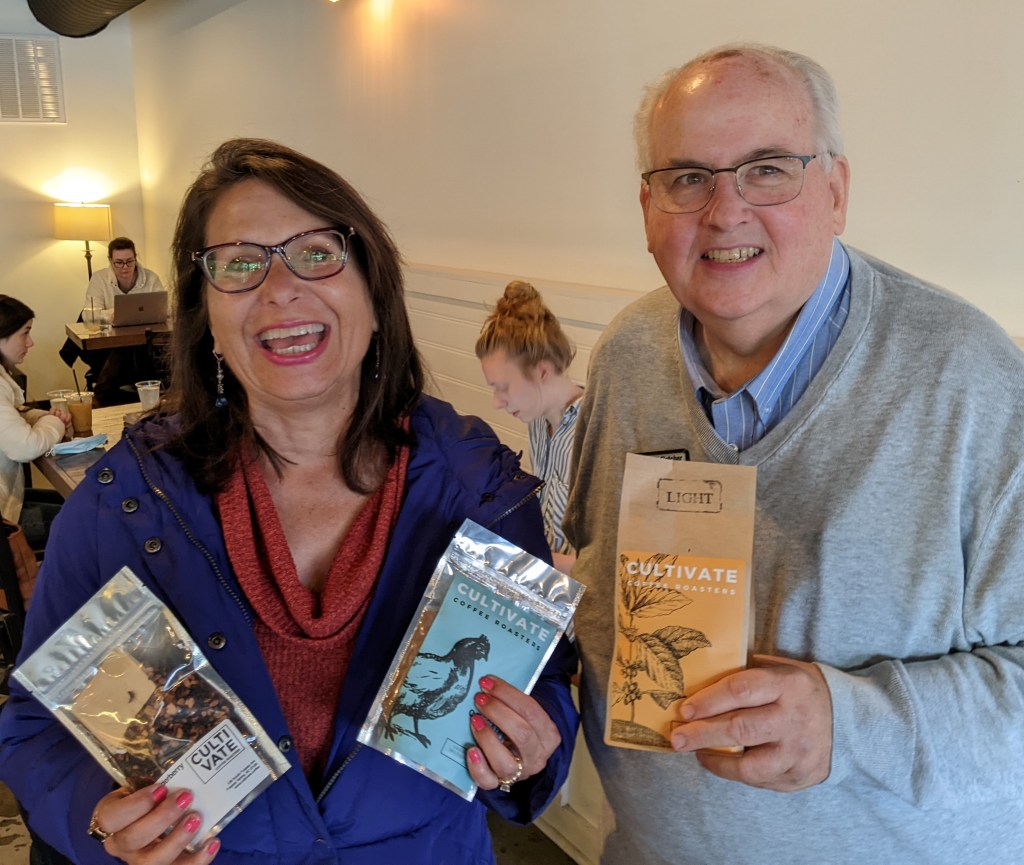
Cultivate Coffee is Bill Fletcher’s new spot for coffee chats.

All the background helped me to re-meet our gracious Inn host John W. Byrne who told us more about Fuquay-Varina and then made dinner reservations for us at Garibaldi. The next morning, we were treated to a delicious breakfast with fresh fruits and then went on another walkabout that took us to Cultivate Coffee and the chance to see Bill Fletcher, a sweet friend who recently moved from Cary.

Portrait of Joe DiMaggio and Marilyn Monroe that is signed by DiMaggio that is one of several incredible artwork that featured in the Fuquay Inn.

At the end of our staycation, John gave us a tour of the Fuquay Inn and that was when I learned that Marilyn Monroe and Joe DiMaggio once babysat John. Hearing the stories of what it was like growing up with a father on the New York Yankees was entertaining.

Our visit to Fuquay-Varina was a delight. We enjoyed getting to know Patty, John’s wife, who teaches English at Campbell University. John is a natural born story-teller and I won’t spoil the other surprises in store for you when you book a weekend at The Fuquay Inn.

About John W. Byrne

When John Byrne moved in 1973 to Fuquay-Varina with his wife Patty, most of the storefronts on main street were empty. In 2000, Byrne was elected to Mayor and served for 20 years. His leadership and attention to detail has successfully grown the downtown area and beyond to becoming a destination spot.  “I believe a mayor needs to be engaged in the community.” One of the ways Byrne gets involved with the community is by walking 5 miles a day and stopping to talk with the people he meets along the way.

Byrne stepped down as Mayor of Fuquay-Varina in 2021. Under his leadership the town saw unprecedented growth and success.

  • Population grew from 8,000 to 40,000
  • Two thriving downtown districts.
  • $50 Million in grants for projects like park development and transportation
  • AAA bond rating for Fuquay-Varina

About Fuquay-Varina

This area seems to grow by twos; two communities and two downtown areas.

Fuquay Springs and Varina, joined in 1963 to form one municipality to become Fuquay-Varina. The little dash that connects the two names is now the logo for the town that is a dash more of the unexpected in town that offers something extra-special.

Two downtown areas offer a mix of shops, breweries, and restaurants. It’s a little tricky to walk to the two sections, but well worth it with Aviator Brewery offering up the best on tap and in the smokehouse in the section just beyond the railroad tracks. The area closer to the Fuquay Inn offers more restaurants and unique shops including Ashworth’s Clothing.