A Cup of Unity: Sisterhood Afternoon Tea for Women Who Minister

Make plans to attend A Cup of Uni-TEA – Sisterhood Afternoon Tea for Women Who Minister where love is poured out, and unity is served with grace, ease, and grit.

A Cup of Uni-TEA is more than just a tea gathering. It’s an opportunity for you to connect with other women who minister in different spheres of influence. on a deeper level and break down the walls that seek to divide us. Together around the cup, lay aside our titles, share our stories, and build a stronger community of support and encouragement that empower us to stand shoulder-to-shoulder and persevere in the face of challenges, as we together build God’s Kingdom.

Saturday, August 17, 2024

12:00 PM-3:00 PM

Hilton Garden Inn,

131 Columbus Ave. Cary, NC 27518

Register by clicking here

Cost: $69

This year’s theme is Pouring Out Grace: Refreshing Hearts and Renewing Spirits

1 Thessalonians 5:11: “Therefore encourage one another and build each other up, just as in fact you are doing.”

Lessons Five and Six: How People Change

The “How People Change” study by Timothy S. Lane and Paul David Tripp “is not one that comes naturally for us. It’s hard for us to connect the ways we think, feel, and act in the midst of struggle with our ultimate destination of life in heaven with Christ. It is a work of the Spirit in our lives. But when we learn how to respond to that work, the impact on our lives is enormous.” These videos are a part of a CtK Study and are shared for participants who missed the earlier sessions.

Lesson 5 – HEAT 1 – The Real God in the Real World

  • Big Question: What’s your situation? What are the burdens, pressures, joys, hardships, temptations, responsibilities, opportunities, and pains – both actual and potential?

Video (17 minutes)

Lesson 5 – HEAT 1 – The Real God in the Real World

Discuss

  • 1 Peter 4:12
  • Phil 1:29
  • Psalm 88 –

Does it bother you that this psalm does not end on a positive note?

Does it amaze you to consider that it was written as a hymn to be sung in worship? What can we learn from this?

  • We can come out of hiding with our struggles, and when we do, we will find that God already knows and understands.
  • James 1:1-18 – What amazing, comforting, pastoral advice. James’s words are full of grace and truth. He does not flinch at the reality of suffering but calls us to run to God. He warns us of cynicism and sin and points us to the God who loves us and has come to redeem us in the midst of our circumstances.
  • Consider how it must have felt to have a fellow sufferer comfort you with these words in the midst of dire difficulty. What does it say to you as you think about a trial you faced or face now?

Central Point: The Christian life is not about finding shelter from the real world as much as it is about God meeting us in the midst of it.

Lesson 6 HEAT 2 –  The Real You in the Real World

Big Question: As God sees me respond to the heat in my world, what in me does he want to change? Where is God calling me to personal change right now?

Video  (15 MINUTES)

Discuss

Central Point

  1. The Bible describes life this way: We live in a broken world as people who struggle daily.

Personal Application

  1. I need to identify the specific areas where I struggle in a world that does not operate as it was intended.

Relational Applications

  1. I need to help others to be honest about their struggles with life.

Personal Growth Project -A process of self-examination

Choose an area of struggle from your own life. This will be the area you use for application in the rest of the class, applying what you learn from the HEAT-THORNS-CROSS-FRUIT model, lesson by lesson. In the Make It Real section of each lesson, you will be given a guided opportunity to take the principles, perspectives, and promises of each lesson and apply it to your particular area of struggle.

How to choose… Relatively minor to major patterns of behavior. Examples:

  • Sports: the way you play/coach competitive sports is a window into your fears, pride, slyness, tendency to live on the basis of your performance, etc. Money & Possessions: Are you obsessed with wealth? Fearful of poverty? Do you daydream about money? Are you selfish? Generous? Given to impulsive or compulsive buying? Covetous? Continually in debt?

  • Work & Rest: Do you alternate between workaholism and a self-indulgent love of comfort? Are you driven and restless? Do you procrastinate and avoid responsibility? Do you pursue leisure in way that pleases the Lord?

  • Grumbling: Do you tend to be negative, pessimistic, complaining, irritable, unhappy, discontent, and dissatisfied? What do you grumble? About what?

  • Secret Sin: Is there an area of sin and temptation that regularly defeats you? Have you found it difficult to admit it and seek the help of others?

Email Liza to learn more or join the group that is meeting two Sundays a month during the Summer 2024. Click here for link to the blog for earlier sessions.

The “How People Change” study guide is written by Timothy S. Lane and Dr. Paul David Tripp who is a pastor, international event speaker, and a best-selling and award-winning author. With more than 30 books and video series on Christian living, Paul’s driving passion is to connect the transforming power of Jesus Christ to everyday life. Click here to view videos and podcasts featuring Dr. Tripp. 

Click here for the How People Change series of blogs.

Lessons 3 and 4: How People Change

The “How People Change” study by Timothy S. Lane and Paul David Tripp “is not one that comes naturally for us. It’s hard for us to connect the ways we think, feel, and act in the midst of struggle with our ultimate destination of life in heaven with Christ. It is a work of the Spirit in our lives. But when we learn how to respond to that work, the impact on our lives is enormous.” These videos are a part of a CtK Study and are shared for participants who missed the second session.

Video 3 Change is a Community Project – God gave you the church to help you change! (26 min)

The Big Question: What daily resources are yours because you are a part of the community of Christ? Are you taking advantage of those resources? What resources and gifts do you bring to the body of Christ?        

Discussion

  • Hebrews 10:19-31
  • Ephesians 3:14-21
Video Three from How People Change

Video 4 – Life as God Sees It, Change as God Does It: A Biblical Model for Change (18 min)

The Big Question: How does “The Big Picture” help you understand and respond to the grace of God as he works through the details of your life?

The Bible gives us more than a set of directions, it gives us the big picture.

Discussion

Jeremiah 17:5-8

Luke 6:43-44: 43 “No good tree bears bad fruit, nor does a bad tree bear good fruit. 44 Each tree is recognized by its own fruit. People do not pick figs from thornbushes, or grapes from briers.”

1 Cor. 10:1-5

2 Cor. 4-11

Video 4 How People Change

Study guide written by Timothy S. Lane and Dr. Paul David Tripp who is a pastor, international event speaker, and a best-selling and award-winning author. With more than 30 books and video series on Christian living, Paul’s driving passion is to connect the transforming power of Jesus Christ to everyday life. Click here to view videos and podcasts featuring Dr. Tripp. 

Click here for the How People Change series of blogs.

Lessons One and Two: How People Change

The “How People Change” study by Timothy S. Lane and Paul David Tripp “is not one that comes naturally for us. It’s hard for us to connect the ways we think, feel, and act in the midst of struggle with our ultimate destination of life in heaven with Christ. It is a work of the Spirit in our lives. But when we learn how to respond to that work, the impact on our lives is enormous.” These videos are a part of a CtK Study and are shared for participants who missed the first session.

Video Notes: Here’s Where God Is Taking You

The Big Question • What hopes and goals give direction to your life?

Key Scripture Passages

• 2 Peter 1:4: Participants in the divine nature

• Philippians 1:3–11: The promise of inevitable victory

• Revelation 7:9–17: A picture of our final destination

Watch Video 1: Here’s Where God Is Taking You (13:43)

Video 1 How People Change

Video Two Notes for “So, You’re Married to Christ”

The Big Question • What daily benefits are yours because of your marriage to Christ?

Key Scripture Passages

• 2 Corinthians 11:1–3: Married to Christ

• Colossians 1:15–23: Christ the Bridegroom

• Colossians 1:21–23; 2:1–15: The blessing

Watch Video 2: So, You’re Married To Christ (17:40)

Video 2 How People Change

Study guide written by Timothy S. Lane and Dr. Paul David Tripp who is a pastor, international event speaker, and a best-selling and award-winning author. With more than 30 books and video series on Christian living, Paul’s driving passion is to connect the transforming power of Jesus Christ to everyday life. Click here to view videos and podcasts featuring Dr. Tripp. 

Click here for the How People Change series of blogs.

Summer Study on How People Change

How People Change” begins with God and makes it possible to embrace a change that is not about fixing me or somebody else. It’s about the One who is remaking us into His image and creating a community of kindness on earth. This is not a 12-step course or system. This is about ongoing, gospel driven, Christ competent, progressive heart change.

The 2024 summer series use videos and material written by Paul David Tripp and Timothy S. Lane that will guide us along the biblical path that points to the cross and a lifestyle of faith and repentance.

Listen in below to hear from the authors as they explain what to expect from this course.

This is what the Lord says: “Let not the wise boast of their wisdom
    or the strong boast of their strength
    or the rich boast of their riches,
 but let the one who boasts boast about this:
    that they have the understanding to know me,
that I am the Lord, who exercises kindness,
    justice and righteousness on earth,
    for in these I delight,” declares the Lord. (Jer 9:23-24)

Dr. Paul David Tripp is a pastor, international event speaker, and a best-selling and award-winning author. With more than 30 books and video series on Christian living, Paul’s driving passion is to connect the transforming power of Jesus Christ to everyday life. Click here to view videos and podcasts featuring Dr. Tripp.  

Dr. Timothy S. Lane is the Founder and President of the Institute for Pastoral Care, a non-profit that equips local churches to care for their people

Click here for the How People Change series of blogs.

Teen Volunteer Opportunities

Summer is coming and there are some wonderful nonprofits in the Raleigh/Durham area that would love to have extra help. Volunteering can provide many benefits for teenagers, including developing valuable skills, building a sense of community, and gaining valuable work experience.

  • Volunteering can help teens develop important skills such as communication, problem-solving, and leadership.
  • Participating in volunteer activities can help teens feel more connected to their local community and contribute to positive social change.
  • Volunteering can also provide opportunities for teens to explore potential career paths and gain valuable work experience.

Here are just a few of the agencies in the Triangle area that can use an extra hand this summer:

A PLACE AT THE TABLE: The pay what-you-can cafe in downtown Raleigh provides food for all, regardless of means. Ages 15 and older can run food, clean tables, wash dishes and roll silverware.

ACTIVATE GOOD: Activate Good’s Youth Volunteer Corps of the Greater Triangle offers opportunities for ages 11-18 to assist in a variety of local causes.

ANIMAL PROTECTION SOCIETY OF DURHAM: Ages 14 and older can help the shelter with hospitality, adoption counseling and more. Volunteers must be 16 or older to walk dogs without adult supervision, and 15 or older to volunteer with cats without adult supervision.

BOYS & GIRLS CLUBS OF DURHAM AND ORANGE COUNTIES: With locations in Durham and Chapel Hill, Boys & Girls Clubs welcomes students ages 16 and older to help the nonprofit with a variety of tasks, including physical education instruction for younger children, administrative duties, and classroom and special events assistance.

DORCAS MINISTRIES: Dorcas Ministries in Cary provides financial and food assistance to community members in need. Volunteers work in the thrift shop and food pantry. Ages 14 and older may volunteer independently; families can volunteer together if children are at least 12 years old.

FUQUAY-VARINA EMERGENCY FOOD PANTRY: Ages 15 and older can assist the food pantry with a variety of tasks.

THE GREEN CHAIR PROJECT: The Green Chair Project in Raleigh provides furnishings and housing essentials to families transitioning into stable housing. Ages 13 and older can assist the nonprofit by processing donations, assisting in the warehouse and more. An adult must accompany volunteers younger than 15.

HABITAT FOR HUMANITY: Volunteers must be 16 or older to build and repair homes for families in Wake. Durham and Orange counties.

THE MIRACLE LEAGUE OF THE TRIANGLE: The Miracle League’s buddy system pairs a player with special needs with a volunteer helper age 12 or older to enjoy the game of baseball. Baseball fields are located in Cary. Durham and Raleigh.

NORTH CAROLINA DOWN SYNDROME ALLIANCE: The nonprofit offers a variety of local opportunities for ages sixteen and older to assist individuals with Down syndrome.

OAK CITY CARES: Oak City Cares on Raleigh helps individuals and families experiencing homelessness, Students ages 9-17 may volunteer for Oak City Cares’ weekend meal program with adult supervision.

PIEDMONT FARM ANIMAL REFUGE: Ages 10 to 18 may perform essential tasks alongside a parent or guardian to keep the Pittsboro sanctuary running.

PLANET PEACE FARM: All ages may groom and feed animals. clean pastures, and plant and harvest vegetables at this east Raleigh farm dedicated to youth.

ALICE AYCOCK POE CENTER FOR HEALTH EDUCATION: The Poe Center for Health Education in Raleigh helps North Carolinians make healthy lifestyle choices. Ages 14 and older may assist with daily operations by helping in the garden, working the front desk, and preparing materials and props for programs.

RALEIGH RESCUE MISSION: The Raleigh Rescue Mission helps individuals and families experiencing homelessness. The minimum age to volunteer on-site is 16; off-site volunteer options for individuals younger than 16 are listed on the website.

SAFE HAVEN FOR CATS: Ages 16 and older may perform various tasks without a parent or guardian at this Raleigh cat shelter; students younger than 16 may volunteer with parental supervision for shelter cleaning, monthly food distribution or reading to cats.

THE SALVATION ARMY OF WAKE COUNTY: With adult supervision, volunteers ages 14 and older may feed the hungry in Raleigh by working in the soup kitchen and washing dishes

SECOND CHANCE PET ADOPTIONS: Second Chance in Raleigh rescues stray or abandoned cats and dogs. Ages 16 and older may assist with cat care, greeting visitors and other needs at the facility.

Table in Carrboro provides healthy food and nutrition education for children. All ages can sort and bag food, prepare garden beds and harvest produce.

URBAN MINISTRIES OF WAKE COUNTY: Ages 16 and older may help independently to pack boxes with groceries and organize food shelves at the facility in Raleigh; a participating adult must assist ages 13 to 15.  

If you know of other agencies that welcome kids and teens, please drop them in the comment section and I will add them to this list – thank you!

Book Review: Moving on Doesn’t Mean Letting Go: A modern guide to navigating loss by Gina Moffa, LCSW

There is not a right or wrong way to grieve the loss of someone you love. “Moving on Doesn’t Mean Letting Go: A modern guide to navigating loss” by Gina Moffa is an excellent guide not only for a reader who needs support with grief, but also for people who want to help a loved one with their loss.

“There is no escaping or outrunning loss in our lives, individually nor collectively. Your job isn’t to conform to some imaginary timeline, to progress through your grief like it’s a couch-to-5K,” writes Moffa.

Throughout Moffa’s book on grief are gold nuggets of wisdom that can be referred time and again. Instead of the five stages of grief that seem to offer a beginning and end point, Moffa suggests that the healing process isn’t like a Netflix series you can binge your way through. In her sharing of her own loss, Moffa discovers the six rules of grief:

  1. It lasts for as long as it lasts.
  2. You don’t need good reasons to prioritize your feelings and needs.
  3. You can grieve in your own way without justifying it.
  4. You deserve support for as long as you need and/or want it.
  5. You don’t owe anyone anything (my personal favorite).
  6. There are no expectations that you need to live up to in your grief.

Another section I found valuable includes the Grief Hall of Fame with offending platitudes that people may say that often miss the mark such as “They’re in a better place” or “It was their time.” Truly how many times have you wanted to cry, scream, or be quietly numb and someone told you to cheer up or smile— so you faked it and did what they wanted?”

Moffa recommends instead of offering hollow platitudes that we just show up as our authentic selves. We can check on our friends who have lost a loved one and offer comfort. While no book can substitute for one-on-one therapy or specialized grief support, Moffa wants the pages to “become a safe space for you— just you and me in this vault with no judgment, no secrets, and no societal or ancestral rules, a space to come closer to our truest selves and gather tools for healing wounds, old and new, one step at a time.”

Pick up your copy of Moving on Doesn’t Mean Letting Go today. After nearly two decades of clinical experience and her own journey after losing her mother to cancer, Gina Moffa, LCSW offers knows all too well how disorienting, painful, and lonely grief can be. 

In Moving on Doesn’t Mean Letting Go, she offers a heartfelt, practical map through loss—one that can shift the pain of your grief even when things feel unpredictable and overwhelming.

About the Author Gina Moffa, LCSW: She is a licensed clinical social worker in private practice in New York City. In the field for 17 years, Moffa has helped thousands of people seeking treatment for grief and trauma. This includes work with Holocaust survivors at 92Y, an international non-profit, as well as being a clinical director for Mt. Sinai Hospital Outpatient Program specializing in addictions. She received her master’s degree in social work with a specialty in trauma from New York University.

Moffa maintains a full private practice on the upper west side of Manhattan. The majority of her practice consists of people seeking support and guidance for a major loss in their life, whether through death, divorce, or an unwanted life transition. One of Moffa’s clinical passions is helping people to navigate their healing from loss and grief in a way that empowers them to find a new sense of fearlessness, understanding, and meaning in the face of unpredictable grief.

Because I Love to Read to Grandkids

Easing into the joy of being a grandmother to eight precious kids brings a renewed passion of reading books that spark a child’s imagination. Last week, I had the chance to share the book “Because I Love to READ” to our grandson who is two-years-old. He loved the illustrations from Noor Alshalabi, especially the one about exploring the ocean floor with coral reefs and a turtle.

What I enjoyed most about “Because I Love to READ” by Dr. Ranjit Joseph is that it’s based on his experiences reading to his daughters. “Creating wonder for our children isn’t just a gift for today; it’s a legacy of love. To all the parents weaving magic every day, our loving hugs, our friendly voice, our shared giggles are the magic spells that make growing up extraordinary. Let’s keep creating those enchanting moments—they’re the heartbeat of a childhood well-remembered,” said Dr. Ranjit Joseph, author of “Because I Love to READ.”

There is no doubt that reading books aloud to kids increases creativity and improved language skills. There are some important skills that children can learn when they hold a book while it’s being read to them. Those skills can include:

  • How to share as you take turns pointing out the images on a page
  • Developing fine motor skills needed for page-turning.
  • Distinguishing between shapes, colors, and words.
  • Relating how the story compares to their understanding of the world.
  • Reinforcing new vocabulary words when they sound out the words with you.

Reading readiness comes at different times to different kids. Some children are ready to read by age four, others may not be ready until age six. Kids don’t have to know how to read to enjoy having books read to them. Make this a stress-free time of simply enjoying a fun book together. It’s one way to prepare them for a lifelong love of being able to read.

What books do you recommend for kids ages 2 to 9 years old?

Because I Love to READ written by Dr. Ranjit Joseph and illustrated by Noor Alshalabi is now available in paperback on Amazon. This charming book tells the story of two sisters who embark on endless adventures while exploring the world through books.

The book highlights many key principles in life in a fun and playful way such as

-having fun and being silly
-the importance of family
-having big dreams
-taking action and trying to make a difference in this world
-fostering a love of reading


Truth about Concierge Marketing

If your big event happened and no one shared it on social media, would anyone know about it? I understand. Sometimes you want to wait to share about the event until your pictures or video are perfect. Unfortunately, if you wait too long after that moment has passed, you may have lost the opportunity to take advantage of your hard work in producing that event.

This type of real-time sharing at an event or just after an event is a strategy that can be offered by concierge marketing specialist. It’s a strategy that FRS Communications uniquely crafts for each client.

We develop a concierge marketing strategy by analyzing how your clients engage with you from their first interaction to repeat business. When you understand your client’s mindset, interests, and passions, you can deliver more personal experiences to them.

This is where real-time marketing comes in. We work with you to brainstorm and develop strategies to reach your target audience before and after an event. This process helps you achieve marketing goals and may be a mix of online and offline tactics such as social media marketing, content creation, email campaigns, partnerships, and local networking. We provide strategic guidance and work closely with you from the planning stage through tactical execution and follow-up analysis.

This is not an easy process, nor is it a one and done effort. Stay tuned for a follow-up blog with concierge marketing tips you can start working on to make your 2024 better than ever!

Creating Christmas Memories

Someone once said that “prior planning prevents poor performance.” This is especially true of the busy holiday season. With a little planning you can avoid much of the franticness, frustration, and even fighting that accompanies this time of year.

Make time before this Christmas season to talk with your spouse, your children, or a friend (whichever applies to your life) and discuss your schedules, your expectations, and your plans. It will calm the chaos of the time of year to answer questions like:

  1. What traditions from each of our families do we want to keep as a part of our Christmas celebration?
  2. Are there new traditions we would like to add this year?

Adapt the ideas to your family. Make them as simple or as complex as you like. Most of all have fun with them as you celebrate the real reason for Christmas. (ideas from “Creating a Christ-Centered Christmas”.)

Prepare the Manger for Jesus This tradition gives us a daily reminder of the true meaning of Christmas.  You will need a manger, homemade of wood, ceramic, or purchased, etc.  You will also want to keep a basket of straw near the manger.  Sometime during the day (bedtime is a great time), have your family gather at the manger. 

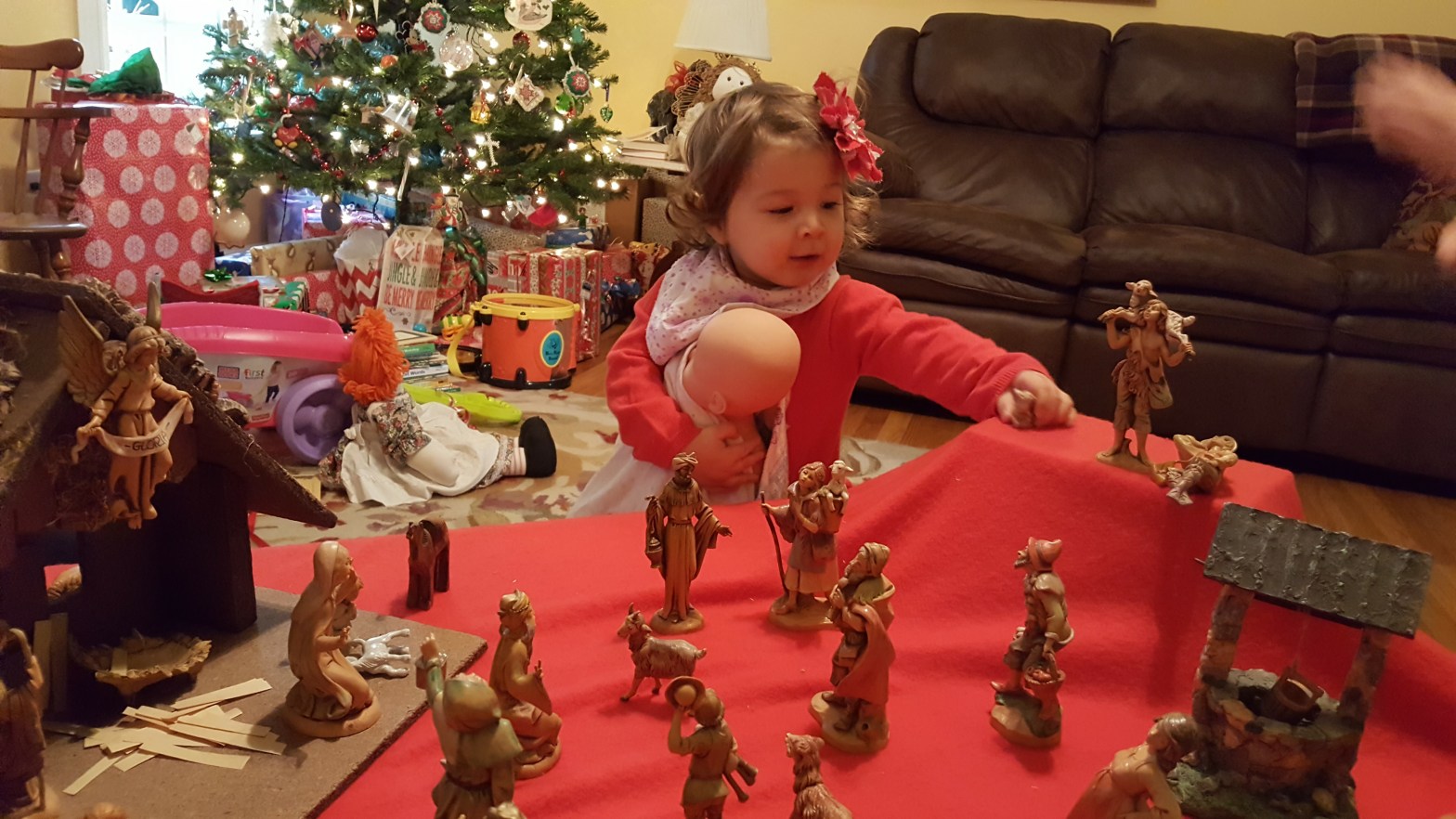
In our home is the special Nativity made with plastic resin shown in the blog picture. Our kids enjoyed retelling the story with the pieces and now our grandkids are enjoying it. Baby Jesus is kept out of the scene until Christmas morning. Throughout the season, each family member adds a bit of straw to the manager as they share what they are thankful for or share some other reflection of the true meaning of Christmas. Our stram is just pieces of cut construction paper.

Then on Christmas, the baby Jesus is placed in the manger on the bed that was built by Christ-like behavior.  This could change the whole atmosphere of your home if everyone is competing for putting in the most straw. First thing Christmas morning, the children run down to see if the baby Jesus is in the manger.

Birthday Party for Jesus: This is especially meaningful to small children, but will be enjoyed by “children” of all ages.  This particular part celebrates not only Jesus’ birth, but also tells the gospel story.

A three-layer cake may be used for this party; however, in our home we use three large, pan-sized pancakes.  We have our party first thing Christmas morning, so it serves as our breakfast, also.  The cake will actually be assembled as part of the party, so you will want to have your table set with all of the components:

  • Three layers of cake (or pancakes)
  • Small Hearts: one for each person present (candy, paper, or frozen strawberries cut in half work well)
  • A taper candle
  • One small birthday candle for each person present
  • Red syrup (we color Karo syrup with food coloring) or red sprinkles
  • Powder sugar or white icing or whipped cream
  • A Knife to cut the cake
  • Matches

Begin your party by placing the layers one on top of the other.  As you place them explain that the bottom layer represents God the Father, the middle layer represents Jesus the Son, and the top layer represents the Holy Spirit.   Read John 3:16. 

Now share that the shape is round, symbolizing the world Jesus came to save.  Border the cake with the hearts, saying these represent the hearts of men that Jesus wants to change. Read 1 John 1:7b

Then drizzle the red syrup or sprinkle the sprinkles over the cake to represent Jesus’ blood shed for our sins.  As the powdered sugar is sprinkled or the white icing is spread, remember that because Jesus shed His blood, we are washed white as snow.

Place the taper candle in the center of the cake and light it as you remember that Jesus is the Light of the world. (John 8:12) Then let each person light his candle from the large candle and place it in the cake, showing that he or he is Jesus’ light in the world. (Matthew 5:14)   The cake is then cut, remembering as we cut through the layers that through the Holy Spirit (John 16:13) we come to God the Father through Jesus Christ His Son (John 14:6).  You can end your party in prayer or in singing “Happy Birthday” to Jesus.

Gift Opening that Esteems Others: In our home, no one begins opening presents until everyone is awake and we have had our birthday party for Jesus.  The children take turns each year being in charge of handing out the gifts.  As the family gathers beside the tree, gifts are handed out one at a time.  As each one is handed a gift, he opens the gift as the other members watch.  The recipient acknowledges the gift.  We try to encourage the children to share why they like the gift and to really appreciate and esteem the gift-giver.  This causes all of us to focus on the giver and not the gift.

Sharing Christmas with Neighbors: Bake Christmas cookies and other goodies and, as a family, deliver them to your neighbors with a card which holds the message of Christmas.

Invite neighbors to drop in for dessert.  You may want to sing carols or open the floor for people to share Christmas traditions or memories.  Before everyone leaves, have someone read the Christmas story, or try to let the children re-enact it.  This may be the first time some of your neighbors have heard the story of Christmas, and if it isn’t it will be a good reminder of what the season is really about.

Get together with several other families and go Christmas caroling in your neighborhood and theirs.  If you can’t carry a tune, just make a joyful noise.  Afterwards, go back to someone’s home for hot chocolate and cookies.

Adopt a Family: Through your church, local ministries to the needy, or social services you should be able to find a needy family to adopt.  Take gifts and Christmas dinner to that family.  There could be an ongoing relationship that develops with the family or you may choose a new family each year.  Another approach is to have your adopted family come to your house and share in your Christmas celebration.

Advent Prophecy Wreath: Create an Advent wreath that is a variation of the traditional Advent wreath with four candles which are lit one on each of the four Sunday’s preceding Christmas. The candles can be any color you have representing a theme of your choice (love, names of God, His character, etc.).  In addition to the candles, this wreath has twenty ornaments which represent twenty fulfilled prophecies about Jesus’ birth, life, death, resurrection, and return.  Our family uses the wreath for family devotional times from December 1-24.  One prophecy and its fulfillment are read and discussed each day, Monday through Saturday.  Then on Sunday we light the appropriate candle.

Materials Needed:

  • Wreath
  • Candle holders to place in the wreath
  • Four taper candles (the colors of your choice)
  • Ornaments (either homemade or bought for the prophecies you want to include)

Ornament: woman (made from mini craft clothes pin with a triangle of cloth draped over the ‘head’)

  • PROPHECY:  Genesis 3:16 – born of the seed of a woman
  • FULFILLMENT:  Galatians 4:4

Ornament: star / scepter (the scepter is made with a tiny Styrofoam ball stuck on the end of a toothpick and dipped in glue then glitter.  The star is cut from yellow felt and glued to the shaft of the toothpick.)

  • PROPHECY:  Genesis 12:3; Genesis 17:19 – descendant of Abraham, Isaac, Jacob
  • FULFILLMENT:  Matthew 1:2-15

Ornament: crown (cut from gold paper)

  • PROPHECY:  Isaiah 9:7 – heir to the throne of David
  • FULFILLMENT:  Luke 1:32-33

Ornament: Manger (made from construction paper, filled with tiny bits of straw or raffia)

  • PROPHECY: Micah 5:2 – born in Bethlehem
  • FULFILLMENT:   Luke 2:3-5,7

Ornament: angel (mini craft clothes pin covered in white felt with foil wings)

  • PROPHECY:  Isaiah 7:14 – born of a virgin
  • FULFILLMENT:   Luke 1:26-31

Ornament: Magi (mini craft clothes pin covered with purple felt for a robe and a strip around the top of the “hear’. The robe and the headdress may be decorated with sequins.)

  • PROPHECY:  Jeremiah 31:15 – attempted slaughter of baby Jesus
  • FULFILLMENT:   Matthew 2:16-18

Ornament: thong sandal (made from brown felt, or use a small one from a doll)

  • PROPHECY:  Isaiah 40:3-5 – His way was prepared
  • FULFILLMENT:  Luke 3:3-6

Ornament: dove (cut from white felt)

  • PROPHECY:  Psalm 2:7 – declared the Son of God
  • FULFILLMENT:   Matthew 3:16-17

Ornament: heart (cut from red felt and split down the center)

  • PROPHECY:  Isaiah 61:1 – came to bind up the brokenhearted
  • FULFILLMENT:   Luke 4:18-19

Ornament: decorated robe (cut a T-shirt shape from white felt and decorate with sequins)

  • PROPHECY:  Psalm 110:4 – Priest after the order of Melchizedek
  • FULFILLMENT:   Hebrews 5:5-6

Ornament: donkey (cut from brown felt or construction paper with a yarn tail)

  • PROPHECY:  Zechariah 9:9 – triumphal entry
  • FULFILLMENT   Mark 11:7-11

Ornament:  Hosanna banner (cut from felt with Hosanna written in glitter)

  • PROPHECY:  Psalm 8:2 – adored by infants
  • FULFILLMENT:  Matthew 21:15-16

Ornament: silver coin (dime or nickel)

  • PROPHECY:  Zechariah 11:12 – betrayed for thirty pieces of silver
  • FULFILLMENT:   Matthew 26:1-5, 14-16

Ornament: lamb (made from a medium pompom ball for the body and a smaller one for the head. Use black pipe cleaner for the legs, nose, and ears)

  • PROPHECY:  Isaiah 53:7 – silent before His accusers
  • FULFILLMENT:   Mark 15:4-5

Ornament: cross (use stick from the yard or toothpicks or even small nails tied together)

  • PROPHECY:  Isaiah 53:12 – crucified with sinners
  • FULFILLMENT:   Mark 15:27-28

Ornament: dice

  • PROPHECY:  Psalm 22:18 – soldiers gambled for His clothes
  • FULFILLMENT: Matthew 27:35-36; Acts 1:9-11

Ornament:  bone (either cut one from felt or a small chicken bone, dried in the microwave and sprayed white)

  • PROPHECY:  Psalm 34:19-20 – none of his bones would be broken
  • FULFILLMENT:  John 19:31-33, 36

Ornament: spear (a small stick or dowel with a foil tip)

  • PROPHECY:  Zechariah 12:10 – His side would be pierced
  • FULFILLMENT: John 19:34,37

Ornament: stone (rock from yard)

  • PROPHECY:  Psalm 16:10; Psalm 49:15 – He is raised from the dead
  • FULFILLMENT:   Mark 16:6-7

Ornament: cloud (cotton ball)

  • PROPHECY:  Psalm 68:18 – He is ascended to the right hand of the Father and He will come again,
  • FULFILLMENT:   Mark 16:19    Acts 1:9-11

Advent Candles

  • Red – His blood shed for our sins

1Peter 1:18-19; 1John 1:7

  • White – Our sins forgiven and washed white as snow

Isaiah 1:18

  • Green – Eternal life is ours through Jesus

1John 5:13; John 3:16

  • Purple – We will reign with Him in glory

2 Timothy 2:12; Revelation 20:6

This tradition allows us to focus on what we celebrate and gives us a real knowledge and understanding of the fact that all Jesus was and is was ordained by God the Father from all eternity and was prophesied many, many years before it ever happened.


Special thanks to Edye Burrell who wrote “Creating a Christ-Centered Christmas” booklet published through A Family Resource. The resource is out of print. Edye gave permission for sharing the ideas and hope this blog helps your family.